Tuesday, July 30, 2013

What a dog wants


Ever notice those dogs who will chase that ball till they drop?  How about those dogs who can grab the Frisbee in mid air.  Why is agility so popular?  Why do our dogs get so excited to do these things?  Any guesses.....?  If you stop and think about it, when you taught your dog to play fetch or how to run an agility course were you happy?  Were you supper excited and showed it when they brought the ball back to you?  The things that your dog tends to care the most about are the things that you were excited about and gave the most positive feedback for.  (Keep this in mind when you go to teach your dog anything, it will get you much farther if you use positive feedback more than negative, you will have a do who is much more enthusiastic to do what you are asking.)

For those who are still trying to teach their dogs how to play fetch here is a tutorial for ya! Enjoy!


Wednesday, July 24, 2013

Adopting a dog vs. buying from a breeder


This is a happy looking bunch aren't they, what do you think they all have in common?  They all have been either at a shelter or rescued from a bad home situation.

I know a lot of breeders, and I know a lot of people who will only rescue dogs.  Is one bad and the other good as is often portrayed?  So often the breeder is villanised, and anyone who buys a puppy from them, while the person who rescues is looked upon as a saint. I personally don't see anything better or worse in either way of acquiring a dog or puppy, and let me tell you why.


It is true that there are many dogs that get adopted and end up living much better lives because they were able to find a family who they fit in better with.  The problem is that there are too many people finding themselves with mismatched dogs.

There are plenty of people out there who would like to own a dog and who don't or are not able to handle the puppy stage.  For people like that I suggest finding an adult dog that is up for adoption.  Another perk with adopting a dog is that a lot of times their personality is already known.  You know if they are shy, or outgoing.  Others will claim more, but honestly anything else comes down to how much time and work you put into your puppy in the first place.  If you want a dog that is good with kids, make sure your puppy has lots of positive experiences with lots of kids. Same with bikes, or men, or even cats.  Sometimes you get a shelter dog who doesn't have those issues, and that can also make life easier. Just because you can tell if the dog gets along with cats or doesn't chase bikes, don't think that a shelter dog has zero issues, most of the time they are there because someone else didn't do their job.  If they had they would not be so easily parted with their hard work.  Sometimes you can find a pet partner from the shelter who will only take a bit of extra training, and being older will the training will only take a few months vs a puppy taking year or more.


When you buy a puppy from a breeder, and you do it right, you should be off to a great start, you have a blank slate on which to create your own "best friend."  True, all dogs come with their own personality,  but if you go to work at the very start you can have a dog who, at one year of age can handle most situations, and should be able to handle being off leash (if you have really worked with your puppy).

Now all that being said, here is the main reason for this post.  I am very tired (as I am sure all of you are) at seeing so many dogs in shelters or posted up for adoption.  Now I know that sometimes things do happen that are out of our control, suddenly becoming disabled, or loosing your home and having very limited housing options.  The problem is that too many people get a dog and then loose interest in it far too quickly.  If we don't want to see the shelters filled to the brim with unwanted pets we need to make sure that  we and our children our educated and responsible.  Spaying and neutering our dogs does help a bit in reducing the amount of unwanted dogs in the shelters, but there is another half of the equation that does not get enough public spotlight.  There are too many people who should not be getting a dog in the first place.  There is a false demand for the dogs, and far to many people who buy or rescue them end up getting rid of them for all kinds of reasons.  

If you are young, going to collage, and don't know exactly what you will be doing, or where you will be living two or three years from now; or are a newly wed couple who want to start a family but aren't quite ready for children yet...please think really long and hard about whether or not you should be getting a dog.  If you have young children and they really want a dog, but you are not sold on the idea, or you think it is a good idea to give them some responsibility, please make sure you understand that you, as the parent, are the one who will ultimately end up being responsible.  Yes I agree pets are a great for children, and if I could do it I would make sure every child in the world had at least some kind of personal access to a dog or a cat. 

The thing is you see, the animal market responds to consumer demand just like anything else that is bought and sold.  The difference between the milk you buy at the grocery store, and the puppy you fall in love with is how long they last.  The fact that a dog lives, on average with good care, twelve to fourteen years means that you should have your life stable enough, or have enough commitment to stick by your new family addition for that amount of time.  I know things don't always go as planned, in fact they seldom do.  No one expected the sudden downturn of the economy and the loss of so many jobs, which meant many displace families, which meant for some sad reason, many displaced pets.  I understand that sometimes the money it takes to buy food for the pet your brought into your home sometimes seems to make or break the bottom line.  The thing is, most of the time, if we budget correctly we can make room for twenty five dollars a month that it takes to feed them.  If you don't think that you would keep your pet if you suddenly had to move or if something in life changes, please reconsider getting a one, much less a puppy.  If you must have a dog, look into getting an older dog, one that someone else was unable or unwilling to keep.  The problem with getting puppies, is not the puppies themselves (unless you get yours from a puppy mill, but that is a whole different discussion, one in which we all will agree on.) but our ability to see our future, and where this new puppy will fit in.

If you are the young newly wed couple, who don't think they are ready for kids yet, you both work full time, and you don't care for cats...you are a great candidate for the senior dog (ages 7 and up).  Most senior dogs tend to spend more time sleeping ( are not needing as much attention as a puppy), don't need as much food because they don't expend as much energy, and love simply being hanging out and sharing the love.  Be aware though that older dogs may have more health issues that mean you might be spending a bit on vet bills to keep your older dog as healthy as possible. 

 Don't think I am saying that people who aren't settled down should not get a dog, just consider your situation, and think about the stage of life you should be getting one at.  Consider what would happen if you suddenly lost your job, or had to move, what would happen then, don't wait till it happens and leave the mess to someone else to clean up, this is a life that you have taken upon yourself to look after and it should not be treated as lightly as it is so often treated.  

I also need to make mention that if you do decide to get a dog, young or old, understand that in order to have a good dog, you have to put quite a bit of work into making that happen.  If you can't commit to training on average 15 minutes of training a day with your dog, if not more if your have an older dog with issues, then don't get a dog at all.  Sure you can pay to have someone else train your dog, but that lessens the bond between you and your dog. Besides that your dog will may or may not stay "trained"once he his home with you because you have not put the time and effort into bonding with him.  You become the fair weather friend who only needs to be listened to when their is something to be gained, and since you don't have a base friendship to work from that will create problems of it's own.

Dog used to have a different role in our lives, they used to be the working partner, their job description was different.  Dogs used to be the farm animal, the "hired hand help."  Dogs were the "wild" animal that kids were allowed to keep because it helped the child, but few were allowed to live indoors with us, sleep on our beds with us, and heaven forbid, eat better food than we do!  Now a days their role is a bit different, they are there to make our lives whole.  They are a furry, intuitive best friend.  Many of us see them simply as our children with fur, yet we will fail to see how badly we treat them when we give them up or give up on them.  If you do need to find your dog a new home please take the time to find a good owner yourself.  Don't simply abandon your dog to a 3X5 chain link dog kennel, what will most likely end in his death, what a horrible way to treat such a friend.  Someone you have invited into your life, to be a friend and companion, yet when the tough gets going, you leave that same friend to live it's last days in terror.

Please be responsible, be reasonable, be resourceful, and above all be committed when you decide to make a furry addition to your house.  If you wouldn't take your child back to the hospital when things got rough, why would you think about getting rid of your dog in the same way. If you are unable to handle your dog because of the lack of training on your part, find a trainer to help your or locate a rescue, or simply put the dog down yourself.  If you are unable to stand the thought of doing any of those things, don't get the dog in the first place.  The animal shelter is there to help reunite a lost pet with it's owner, not for you to abandon your friend at.


Sunday, July 14, 2013

Why positive works best

"If we can teach Killer Whales to pee in a cup, you can teach your dog without punishment." ~Ted Turner, Head trainer at Sea World

It all started back in the 60's when a woman named Karen Pryor was asked to see if she knew how to train a dolphin.  Her husband worked at the newly built research facility in Hawaii where they were trying to study the behaviors of wild marine mammals.  They had a problem however in getting the animals they were trying to study to work with them.  They had also wanted to train the animals to put on shows for people to pay money to watch to fund their research. The problem was the animals were not wanting to cooperate.  How did you go about training an animal that you couldn't punish?  The dolphins would starve themselves rather than give into any punishment form of training, and that rather defeated the purpose.  So that left them in a rather unique circumstance, you can't force a dolphin to do what you want, but how do you ask it to do something when you don't speak the same language?  

operant conditioning
n. Psychology
A process of behavior modification in which the likelihood of a specific behavior is increased or decreased through positive or negative reinforcement each time the behavior is exhibited, so that the subject comes to associate the pleasure or displeasure of the reinforcement with the behavior.  thefreedicitionary.com


Karen started using a marker to indicate there was a reward coming after they did something she wanted.  At first it was swimming from one end of the tank to the next, then they placed a rope across the pool so they had to swim over the rope to get to the other end where their reward was. Gradually the rope was raised, and instead of blowing the whistle (which was her marker) after they had jumped over the rope, she stared blowing as they were over the rope. That gave the dolphins the information they needed to continue receiving their yummy reward.  The dolphins understood that only when the whistle was blown would they receive their treat, so by blowing it when they were up in the air, it changed the criteria for what they they had to do to get their fish.  Thus "clicker training" was born.  Karen used this new concept to then train horses, a crab, and even a fish. Now it is widely used to train everything and everyone, from golfers and gymnasts( they call it TAG training), to service animal and zoo animals.

So if you think that your dog is too stubborn, or not smart enough tell that to the tiger and the goldfish, both of whom have been trained using this method.

Clicker training establishes trust and a good work ethic between two beings who may or may not have very much in common.  You can teach your dog that it is in his best interest to not run out the open door the same way the zookeepers teach a several ton elephant that it needs to hold it's ear out for a blood draw.  That elephant did not start out thinking that that poke on it's sensitive ear is the most fun it has ever had, just as your dog doesn't think that sitting for you and not chasing that squirrel across the street is the most fun at first either.  However just as we teach our dogs that catching a Frisbee or a ball, then bringing it back to us and dropping it at our feet is fun, so too can we teach them that coming when called or letting other people pet them is fun as well.  Don't forget that enthusiasm is catchy, and one of the best spread things around!


Wednesday, June 26, 2013

Rules for Clicker Training

This is going along with the theme from my last post Dog Training Secrets.  I am going to make a big poster board one of these days and take it to my classes that I teach, not because people are always breaking the rules, but because I say them so often that I forget if I have said them or not in which class.  So I thought I would break them down here first as my "first draft" and spare the actual poster board a few drafts at least.

Rule #1
Only Click the clicker when the dog is doing something you want it to do.

That means you don't click to get the dog's attention.  You don't click when the dog is ignoring you.  You don't click when the dog is jumping up on you (unless that is something you want).

Rule #2
You always treat after you click.
I don't care if that is a fun toy, or a yummy dog treat, or a piece of hot dog.  If you want the clicker to carry the maximum potential for your training you need to keep it "working."  If you get in your car and turn the key and nothing happens what happens to you immediately?  You start to think, "Oh crap! The car isn't working!" You feel stressed, and angry right?  This is the start of what is called an extinction curve.  If, from then on out, that car never started for you, you would eventually stop doing what it was (putting the key in the car) that used to work and now doesn't.  You don't want to do that with your dog.  You want the clicker to remain like the key to the car that always starts.  If your dog hears the click, then doesn't get a treat like he expects, he too will start to go through an extinction curve. Just like you he will get frustrated, and start to think that the clicker is "broken". He will no longer see it as the means to his reward, thus it will loose it's motivational power.

Rule #3
Time the click, not the treat
 Your timing needs to be the thing your focus on first.  The treats can come 15-30 seconds later (after the dog knows to expect a treat after he hears the click).  Don't forget to offer the treat, but it's the timing of the click that is actually giving the information to your dog and doing the "training" work. So make sure you are clicking at the right time and don't worry your dog will wait for you to fish the treat out of your pocket or grab it from the table.  I find that it helps to hold a squishy treat (like a Greenies Pill Pocket) in the same hand as my clicker, then I simply squish a bit off after I have clicked.  If you need to practice on your kids or by using a bouncy ball to get your timing down, don't be embarrassed.  It does not always come easy to learn yourself, how to coordinate all those things going on, but with practice it does come easier.

Rule #4
Phase the clicker out
You don't want to have your dog dependent on the clicker forever, right? Once your dog understands what you are asking of him, and will do it consistently, phase the clicker out until you are no long using it for that particular cue.  You can still use it to teach something new or continue teaching something else, just stop using it for things they are good at doing. It is nice however to make sure you  give them positive attention when they do what they have been asked.  A treat now and then never hurts either, after all what is the reason you drag your butt to work every day?  You go for the paycheck right?  Make sure your dog continues to feel good about doing what you ask, by giving praise and who in their right mind ever minds a freebie (treat) just for being good.

Friday, June 21, 2013

Top Dog Training Secerets


So I assume you have a dog or are planning on acquiring one in the near future, right?
So you are looking for some tips on how to train, you know there are books, but each book has their own method, and so does every trainer, it can get rather confusing huh.  What does your gut say, forget about what you have or have not been told.  You like your new dog?  You want him to like you too correct?  Keep this in mind when you go about your training.  Your dog is smart, smarter than you  possibly give him credit for, even if it is an eight week old puppy, or an older senior dog. They watch us all the time and are able to read us like a book in a few days.  They know that look on your face that says "look out, he's mad!" They also know when you look sad and need a friend, or when they can get away with things because you won't catch them in time.
Here is one of the first dogs I taught when I moved here, beautiful isn't he.  He's a great dog and his family loves him.  He is very smart, just like you, see the happy confident smile on his face? That would not be there is we had used punishment or dominance based training. Remember that line in the movie "Night at the Museum?"  Where the monkey and the night watchman are having a slapping contest? "who's evolved?"  Keep this in mind while training. Your dog does not reason things out like you and I do, they live in the moment, they don't mull things over, they remember what has worked in the past and apply that to their future.  I don't use e collars, or shock methods, I don't use pinch collars, or choke chains either, all for the same reason, as  Ted Turner from SeaWorld said," If we can teach a Killer Whale to pee in a cup, you can train your dog without the use of punishment. 

Remember, your dog is your friend, not a prisoner of war, so treat him as such.
 I use the clicker training method (which was started by working with dolphins) and found that it works wonders on all dogs, fearful, aggressive, excitable, or just happy go lucky.  Methods aside, there are two keys that you need to have in order to be successful at training your dog to do everything from potty training, to agility training. Are you ready for them? Ready to slap me with that clipboard yet? :o) Two very simple set of rules,
Number 1. Be Clear
Number 2. Be Consistent
What? That's it?  Yep, that's it.  Methods aside, these two things will either make or break it in training.  These two things spell the difference between having accidents in the house and not, and for how long if you have already had a few slip ups.

Sound simple?  Well, it is, and it isn't. Let me explain.  Number 1. Be Clear.  This means taking time to think through what it is exactly you want your dog to do.  This is where a trainer or a book that has things set out in steps can come in handy.  You need to explain to your dog that you want him to put his butt on the ground when he hears the word "SIT."  Well that sounds simple enough to you and me, but we speak English and know what the word "SIT" means.  What if someone told you "S'ASSEOIR" (yes this is a real word).  Would you know what to do?  The reason the clicker works so well, is it acts as a translator of sorts, telling your dog that whatever he did within a second of hearing that clicking noise will get him a treat or something he really wants (I start off using food that they love and then later move to a toy if I can when I first start using the clicker).  So he quickly starts to put two and two together and soon realizes when you say "SIT" and he puts his butt on the ground, everyone is happy, including him.

 The next thing you need to do is Number 2 on the list Be Consistent. This again sounds easier than it really is in practice.  If you say "SIT" and your dog simply runs off and ignores you, you have a problem.  Your dog is telling you that the word "SIT" means only when he wants to, and not when you want him to, or he doesn't really know what the word means.  He might think "SIT" means putting his butt on the ground, but only if you are standing right in front of him, or he has a leash on.  You need to ask for a sit in all kinds of circumstances to make sure he understands what "SIT" really means.  Being consistent also means that when potty training, you set up a food and water schedule and take your puppy outside to do his business (I then recommend clicking and rewarding every time you catch them doing potty in the correct place as well as telling them, if you catch them, that they did it wrong in the wrong place).

Being consistent means taking the time that is needed to make sure your dog really understands what it is you want him to do.  If you don't want your dog to jump on people, then consistently only give him attention when all 4 paws are on the ground.  Sometimes that means helping them by getting down to their level when they are smaller, and showing them that they will get the attention they crave, they just need to be polite when asking for it.
The bottom line is training takes forethought and a plan for it to work the best.  Take 5 minutes every day to work on one thing at a time, take training at their level, which will be different for every dog, and show compassion and understanding for what they are trying to do.  Doing this you will go far and have a dog who trusts you.  If you do hit an unforeseen snag with your dog, don't feel ashamed at needing to ask for help.  Even trainers talk their problems over with other trainers when they come upon a problem they can't see the answer to.  By being consistent, and clear in what you do teach your dog you will find that things will go much more smoothly and keep frustration levels as minimal as possible.  If you are having problems sometimes it helps to have someone watch you and tell you if you are being clear, or evaluate yourself and see if you have been as consistent as you should have been.  Dogs will test your rule boundaries every once in a while, so be prepared to have that consistency be tested every once in a while.  There are reasons that people draw comparisons to raising kids and training dogs, sometimes they are eerily similar at times! 

P.S. Don't forget to have fun and be fun, remember "a spoonful of sugar helps the medicine go down"!

Thursday, June 20, 2013

The cutest dog trainer yet!

I know I'm a bit biased when it comes to the title of this post, but she really is super cute to watch.  We had a few treats were were giving Roxy and my daughter just started asking her to do all these things that she sees me doing with her and I just couldn't help but pull the camera out and record, and now you all have the chance to see that age has nothing to do with the ability of getting your dog to do what your asking it to do.  Marian is quite sure of herself and is clear in what she is asking Roxy to do, that is all you need as well.  Enjoy :o)


Sunday, May 26, 2013

Getting rid of Dog Anxiety behaviors

Ok so my post on the results of teaching Griean, the Irish Wolfhound, how to cope around people and other dogs and how to not be so anxious got a lot of attention.  That tells me there are a lot of you out there with similar problems.  In fact, I feel fairly safe in saying that from the amount of dogs I have seen with anxiety problems, it's reaching epidemic proportions.  The more we come to understand what problems and behaviors stem from anxiety, the more I see it everywhere.

It can start before you bring your pup home.  The quiet shy dogs tend to develop anxiety issues more often than their outgoing siblings, seeing as they are already a bit more nervous around strange new things, however one incident can change all that.  


Say you are on a walk with your dog and you pass someone else doing the same thing. One dog is more likely than not to be more outgoing and wanting to check the other dog out.  If your dog is more shy it will more than likely feel trapped and then fear sets in.  Now there are a number of ways this can play out, lets say the other dog gets really excited and highly aroused at the sight of another dog, so it starts to pull and can seem a bit aggressive to your shy dog who just wants to be left alone.  The other person gets the hint and after a few moments of terror for your dog, the other person succeeds in dragging his dog away and the scary moment has passed.  Or so you think.  What has been taking place in the mind of your dog may not be the same thing that is taking place in yours.

How would you feel if you were tied to a rope and couldn't get away and suddenly a big, tough looking guy came running up towards you?  Does your pulse quicken a bit? You feel a bit of that fight or flight syndrome starting to take effect?  The thing is a dog can't tell itself that "things will be ok," dogs live in the moment, they don't think much beyond the time they are in.  So here you are stuck in the is fight or flight state with no real means of rational thinking. All you can think of is "Please leave me alone", "Don't hurt me," and if that doesn't seem to be working, then teeth get barred and the thought process turns to "I can protect myself."  See your dog is stuck to you, it can't run and hide, or even maneuver away from the other dog, it's stuck face to face with a terror that won't leave.  When it does leave it is normally a lot of times after your dog has showed aggressive body language.  So if your dog finds that showing aggression when it feels threatened and the threat retreats believe you me it will do it again.  It reinforces in your dogs mind that in order to get rid of a threat it needs to act aggressively.

No all dogs have good doggy manners.  Most dogs are in new homes at the time their mother would start to teach them the dos and don'ts of doggy manners.  6 weeks is way too young for a pup to leave it's mother.  Her job of keeping her pup alive is done, but she hasn't even begun to teach the little ones how to interact with others.  Even 8 weeks only gives them a little lesson.  If you take your puppy home by that time it is up to you to find and provide the appropriate positive socializing for your dog.

Now that you have a slightly better understanding of why your dog is acting the way it does it's time to learn how to fix the behavior.  For every dog the time table is going to be different, but most see a dramatic change in their dog within two to four weeks.

I will give you the "recipe" for getting rid of the fear of people, and you can take and apply it to the fear of- fill in the blank. 
Above you see me holding a clicker.  They don't cost more than a few dollars and you can pick on up at your local pet store, or online.  The clicker works by creating a positive memory in association with it's use.  So if your puppy (or dog, age does not matter) is scared of something you want it to start to have positive interactions with what scares it.  This will counter the negative memories or fears that it has and pretty soon that scary looking person over there becomes something that always brings good positive feedback.

So, step one, buy a clicker.

Step two buy your dog's favorite treats (you can be creative, use canned dog food, a cooked cut up chicken breast, or the the dog treats that I have found most successful are the Greenies Pill Pockets, or Bill Jack dog treats)

The way the clicker works is you click for the wanted or desired behavior, in your case not acting scared, and then you give your dog a treat. (you can use toys such as balls or rope tug toys if your dog  LOVES them more than anything else, otherwise I recommend starting off with treats, then you can move over to using toys later).

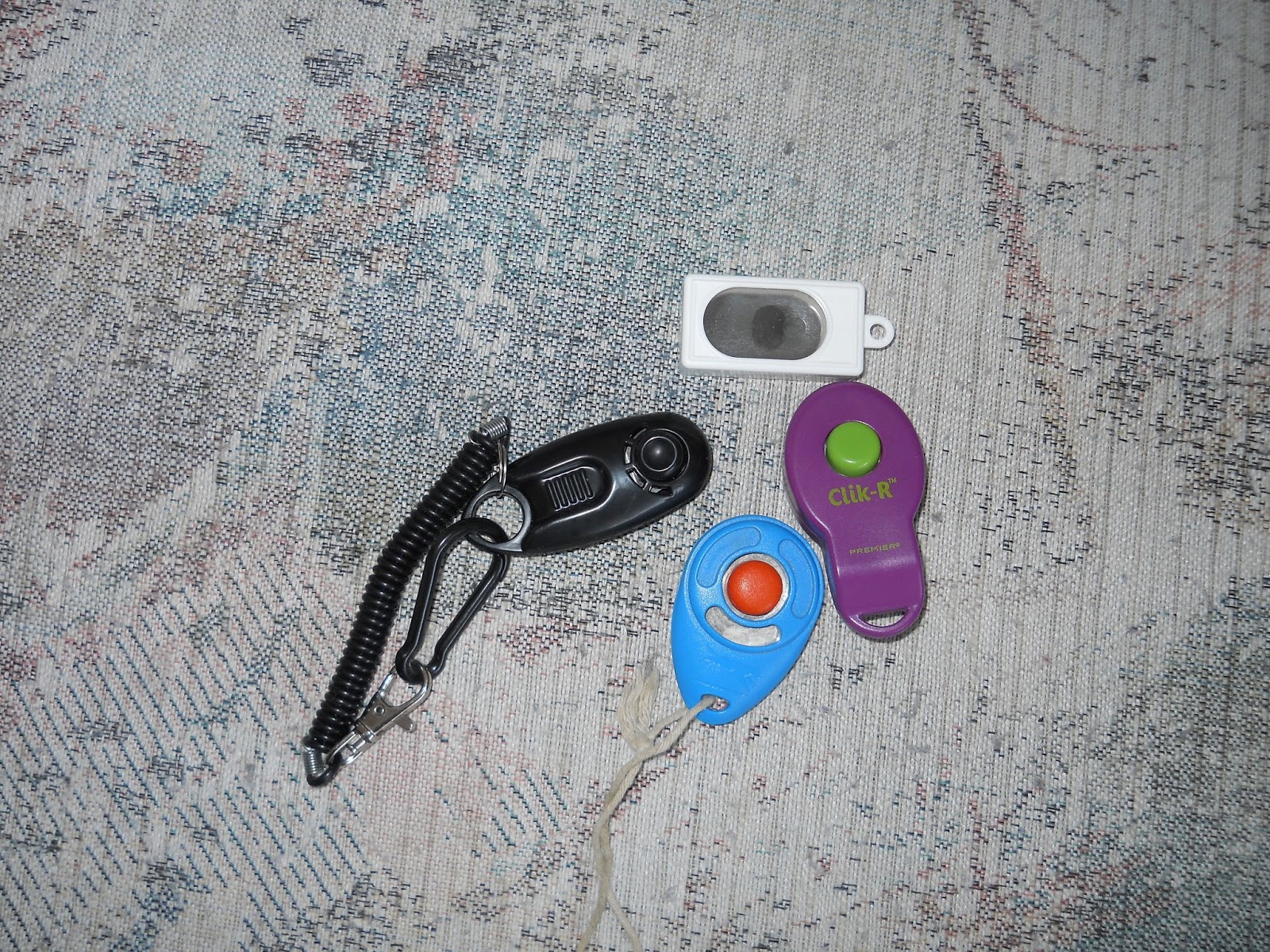
These are all types of clickers ranging in price from 1-5 dollars

Now if you can set up this scenario with a friend it works the best, if not you can normally find plenty of people at a your local pet store or on a walk who would be willing to help you.  You will need to watch your dog closely to know just how close or how far away other people or dogs need to be before your dog starts to get nervous.  This is the line you don't want to cross.  If you are walking down the street and your dog's behavior changes from easy go lucky to alert or stiff, this is too close.  You want to be able to click and treat while your dog is still in happy go lucky mode.

So you see a person approaching, your dog is still ok, click and treat.  The person is getting closer, your dog is still ok, click and treat. ( I tend to count in my head and click and treat about once every second or two at this stage)  If your dog is still acting happy (and a lot of them are because they are getting clicked and treated) you can keep moving forward while clicking and treating.  As soon as you notice your dog loosing interest in you or your treats, or looking nervously at the approaching person, have the person (if they are working with you) stop and back up a bit, till your dog is looking relaxed again, then start the click and treat while the person stands there.  If your dog can relax good, end there and start again the next time a little before there and continue.  If you don't know the person walking towards you, cross the street or turn down a different block so the person is no longer in view, if your dog regains it's composure, you can start to click and treat again. Once you can return back the way you came, do so.   Remember your dog is seeing this approaching person as a big scary looking goblin or monster.  Don't simply blow your dog's fear off because "it's just so and so from down the street."  For whatever reason (which you will most likely never know) your dog is scared and does not understand that that person (or dog) is not going to try to hurt it.

To help move things along a bit faster it helps if you can use the clicker for things at home too.  Teach your dog to spin, or roll over.  Teach him to touch your hand with his nose or put a paw on a box or basket using the same method as above.  Put your hand out in front of your dog's nose, when he puts his nose on it (most dogs do to investigate) click and treat, and then repeat! The more positive things you can teach your dog with the clicker, the stronger the positive meaning the clicker will carry.

As soon as you can get your dog to not be scared as the person approaches, start having the other person give your dog the treats.  They can toss them to your dog on the ground, or if you are sure your dog is ready,you can have the person's hand the dog the treat after you have clicked.  Soon people become walking treat dispensers and your dog won't remember what was so scary about the fun treat dispensers!  After your dog is happily greeting others, you can phase the clicker out along with the treats.  Thought it might still be a good idea to once in while give your dog a treat after all he has come a long way and it has been a lot of work for both of you.

Please feel free to comment on how it has worked for you, or ask any additional questions and I will try to address them as well.