Thursday, January 17, 2013

What is a good recall?

Today's article comes from:

http://www.patriciamcconnell.com/theotherendoftheleash/
(and to read more great articles look here as well!)

Safe Off Leash?

Last weekend Jim, Willie, Tootsie and I stayed in a lovely log cabin owned by friends in the woods in eastern Wisconsin. I mention that because for the first time in her nine years of life, Tootsie got to run off leash in an unfenced area off the farm. Wooo Hooo! Some people might not understand what a huge step that was for a little puppy mill dog, but I’m guessing that many of you get it completely. I was over the moon with happiness that I could unsnap the lead, and trust that she would stop when told, come when called, and as importantly, get to sniff and explore with more freedom than she’s ever had in her nine years of life.
The decision I made got me thinking about the issue in general: When IS it safe to let a dog off leash? What do you need to know to evaluate the risk and decide whether to take it? I thought it might be an interesting exercise to list some of my criteria and decision points in regards to Tootsie, and to hear your thoughts and experiences in addition.
I should probably mention here that it is my belief that one of the things dogs want more than anything in the world is acertain amount of autonomy. Some dogs have a ton of it, others almost none, but surely every dog wants to be able to do what she wants to do, when she wants to do it at least some of the time. Being off leash fulfills that to a great extent, but it also puts dogs at the potential of risk. So how does one decide when to unsnap the lead? Here are at least some of the things that need to be considered:
CONTROL: It is something of an irony that the more control we have over our dogs, the more freedom we can give them. Never is that more true when asking if a dog can be safe off leash, and it was the question I asked myself late Friday night when I decided it was 99.999% a sure thing that once off leash and out of the car, Tootsie would sniff around, relieve herself and then immediately come when I called. But how does one know if a dog will come when called in any context?  Ah, you don’t, not 100%, but here’s what I think you need to get to 99.9999%:
STOP ON A DIME: People often assume that all one needs to manage an off leash dog is a good recall, but I’m a big proponent of first teaching a dog to stop on cue. Asking a dog to stop on a dime might be critical for the dog’s safety, and if you think about it, that’s a very different exercise than asking a dog to come back to you. I can’t count the number of times I asked Willie to stop and stand still (I use “Stand,” a cue common in sheep herding that asks a dog to do exactly that: don’t lie down, but stop moving). Perhaps he was starting to sniff beside a partially frozen stream, or I wanted him to wait for me to catch up before he went around a corner on a trail we were walking.
Besides being a handy cue, I’ve learned it is much more effective to ask a dog to stop first before calling him to come back to you, especially if he is moving fast in another direction. Think about it: If a dog is running away from you, in order to back to you she has to 1) stop, 2) turn around and 3) come back to you. That’s three things, right? I’ve found it far more effective, especially with dogs who love to run, to teach them first to stop on cue before asking them to do a recall. It’s not all that hard to do: Just let your dog get a step or two ahead of you and say “Whoa!” or “Stand” and then reinforce with something ridiculously wonderful. Gradually use the cue when the dog is either 1) farther away from you and 2) moving faster. Try to keep those 2 components separate as much as you can, and gradually build up to asking the dog to stop while tearing off in another direction. Manage this carefully though and set your dog up to win: don’t yell “Whoa” when  your beagle is disappearing into the woods after a rabbit if you haven’t gotten full compliance at a much easier level. However, a good stop is not enough…. you also need:
A RIDICULOUSLY GOOD RECALL: Coming when called when there’s no environmental competition simply doesn’t count as a “good enough recall”. One of the reasons I decided to let Tootsie off leash in the woods last weekend is because we have spent several months working on her coming when called while running away from me at a dead run toward something she really, really wanted. I’ve worked on her recall ever since I got her a year and a half ago (if you missed those blogs, she had been a puppy mill brood bitch for 7 years). It took me months to let her off leash at the farm, and then only in specific contexts in which I felt her behavior was completely predictable. But it’s one thing to have a dog come when called in a predictable and consistent context. It’s an entirely different matter to be able to get a dog to come to you when it is already dashing away toward something it wants.
I was lucky here, because the farm provided the perfect set up. First, I have several fenced areas where I could safely let Tootsie off leash and work on her recall. The area around the house and barn is not fenced however, and has a road that runs by about 75 yards from the house, so I was much more cautious about letting her off leash there. In that context I first worked on teaching Tootsie to heel beside me as we walked from the house to the barn. She adores food, and so it didn’t take long to get a reliable response. Then I began asking her to stop or recall when I released her from the heel. I knew she would run straight to the barn, so I had no worries about her safety. I had her favorite food (chicken) in my pocket and asked her to stop the first time when she had just barely left my side. Gradually I began to give the cue when she was farther and farther away from me. Once I could get to her turn on a dime and run back to me even when twenty yards away I began to test it in other contexts. And sure enough, she flipped her little body in mid-air and came running.
CONTEXT: Location, Location, Location. Realtors aren’t the only ones who emphasize the importance of location. There are simply many places I would never let Tootsie off leash. Here’s an example: we went recently to visit a friend who lives in a suburb, with a small lawn between the house and the road. I asked her to potty before we went inside, and never would have considered letting her off leash in that context. Why? Because first, we were just too close to a road for comfort, she could have gotten into the road before I could blurt out a cue. Second, what would be the point? The cost/benefit balance was skewed far to the negative: the risk in no way was worth the pay off. At the cabin however, the closest road was a good 600 yards away,  and the payoff was huge. She got to be a dog off the farm for the first time in her little life, and although I’m sure some people would argue one should never take any risk at all, I’m not one of them. The only 100% guarantee of safety for Tootsie was to live in a cage, and she’d already done that for seven years. Enough is enough.
WHO’S YOUR DOG? If asked to name three things we all needed to consider before letting our dogs off leash, I’d say knowing each dog as a personality is the third. Tootsie spent 7 years in a cage, and didn’t know that the noises people made were meaningful for most of her life. She’s come incredibly far, but she’s still a Cavalier King Charles Spaniel that I got at age 7 who had never been trained to do anything for most of her life. Willie, on the other hand, came with recall software pre-installed. I could just about take him anywhere and let him off leash, although I still don’t take chances, because, really, what’s the point?
NEVER DONE: One last point: Don’t ever stop “training your dog to come.” I still often reinforce Willie for coming when called, sometimes with voice, sometimes with the toss of a toy or letting him chase me as I run away from him.  And I’ll never stop watching Tootsie like a hawk if she is off leash, and reminding her how very, very fun it is to come when called.
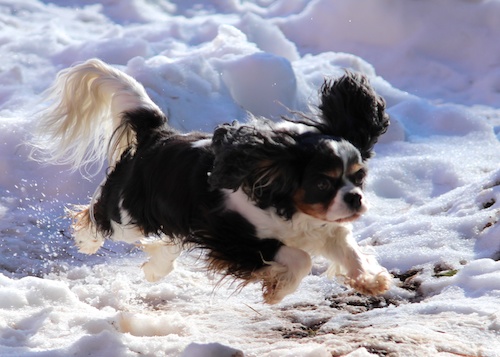
Here’s the little girl now, rounding the corner of the barn when I called her back to me from a dead sprint. She looks so serious, doesn’t she? But damn, she sure comes running!
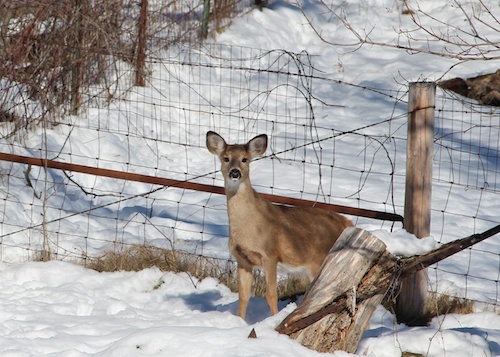
MEANWHILE, back on the farm: A bit of a sad day. We’ve had a doe fawn living in the Orchard Pasture all spring and summer. Something was terribly wrong with her, she clearly wasn’t able to cope with living on her own. She would run smack into the fences at a dead run and was never able to jump them like all the other deer. She did well over the summer when there was a lot of food, but because she stayed in a very small area there was no way she was going to make it through the winter. There was also the concern about coyotes; eventually they would have found her and killed her. And so I contacted a DNR warden who came out, agreed that she was probably blind, and that she would slowly starve over the winter. Deer can’t be captured and re-located (they die of stress, it is horrifically cruel to try to capture and relocate them), and it was inevitable that the coyotes would find and kill her. The warden agreed that she should be put down, and did so humanely with one perfect shot. I know it was the right thing to do, and I know that deer are as common out here as beetles, but oh lordy they are lovely animals, and I’m feeling a big of sadness that such a beautiful thing didn’t make it.
Here she was yesterday:
Tuesday, January 15, 2013

The evils of the Vacuum!

First of all I quite like my vacuum, thank you very much. For some strange reason Roxy does not.  Even my cats are ok with it, Roxy seems to think it is constantly growling and seeking her toys. (note she is not possessive about things normally).  However, turn that darn vacuum on when she is in the same room and she thinks it her job to forcefully remove it from the premises!

She gets worked up very quickly when it is turned on.  Even when it is off she will follow it suspiciously, waiting for it to "growl" and give her licence to use force to remove it.  Now before the move (and the huge amount of stress that it added to her little life) I could just give the "Leave it" command and she would back off and just keep a wary eye on it. However yesterday when I turned it on she would "leave it" for 15 seconds, then she would dive right back in (as if it was the reason behind her stress issues).  So here is what I did (and will continue doing over the next week or so): 

The first thing I did was start using the vacuum without turning it on (I needed to know if it was the sound or just the motion that would trigger her need to attack it).  Turns out now it is just the motion of the vacuum. So I started clicking her for not going after it.  She could run around it and look concerned, but if she didn't attack it she got the click. 


(hope you enjoy Genesis, and let me tell you how hard it is to click, film, and run the vacuum!)


Now in this next clip I turned the vacuum on to see how much the previous clicking had helped. Watch her face as she still is concerned about the "monster" in the front room, but quickly changes into, oh boy I am getting clicks, watch mom, more clicks.  Then one of the cats walks into the room (off camera) and she is then more interested in the cat than she is in the vacuum. She will still need some more work (obviously) but, that is a very good start.  Now the consistency part can go to work.  Every time I bring out the vacuum, all I need to do is click her for watching me instead of the vacuum and, just like with the doorbell, she will become desensitized to the vacuum too!
Oh and by the way after working with her so much yesterday she was quite worn out!

Monday, January 14, 2013

The door bell blues no more!


Does your dog go crazy every time the doorbell rings, or someone knocks at the door? Do your sleeping babies get woken up or you feel like your dog turns into Jekyll and Hyde?  If you are like me I don't mind a couple of barks (I used to call Roxy my long distance doorbell because she would let me know someone was either coming to the house or if my doorbell didn't work, that someone was at the house) however I don't like it when dogs get all worked up and won't calm down, and if my kids get woken up because my dog was barking at the door, I am in a really bad mood before I even open the door to see who it is.  So how do you get your dog to either stop barking when you ask, or only bark once to alert you, you ask?  Most of the time I have told people to ask a neighbor to come knock at your door, or do some sort of set up, but it takes time, and sometimes the most convenient time for you is not so convenient for others. So here is what you do...


Here is a link to a website that gives you sound bites of different knocks on different types of doors:

http://www.sounddogs.com/results.asp?Type=1&CategoryID=1021&SubcategoryID=56

and here is one that has the same thing for doorbells:

http://www.soundsnap.com/tags/doorbell?page=1

You might have to scroll through some of them until you find the one(s) that set your dog off, but then you simply play and replay the knock or bell and click when your dog does what you want.  That way if you have 10 minutes while you are waiting for something, pull it up and do a little training with your dog.


If you want your dog to not bark at all when someone is at the door it is best to desensitize your dog to the sounds above.  Simply click when the doorbell is rung, or the knock has played. Do this for even 2 minutes and most dogs will begin to equate the doorbell with the click.  Most of the time your dog barks is because they are anxious when they hear the sound.  It means someone they don't know is coming to the house, possibly inside, and that makes them slightly apprehensive, or on the other hand, if your dog is overly excited when he doorbell rings, you will want to click when your dog is sitting nicely and not barking. (A yellow lab comes to mind, but there are plenty of others who might fall in this category as well)

If your dog falls into the "other hand" category, here is what you need to do.  Before you start playing your sounds start off your session by asking for the basics (and click and treat for them even if you don't normally, this will tell your dog hey I am willing to pay even for small things today) It will make you dog pay closer attention to you.  So ask for a sit/stay, maybe a small trick or two, then make sure your dog is paying close attention to you by moving just out of his line of vision and calling his name, if he looks or comes to you click and treat.  Now you are ready to start playing  your sounds.  Play it once, if Fido starts barking or jumps up and runs to the door, calmly ask for him to sit, or come and sit (don't click until he is doing what you asked).  Once he is calmer and sitting you can click and treat.  Repeat as often as you need until he understands when the doorbell rings or someone knocks it pays to stay calm. (then you also need to give him plenty of praise when he is doing it right after that, most of the time just a "good boy/girl is good enough)


Wednesday, January 9, 2013

Sit Spot Click comes to Portland!

Hello Portland! We made it! Sit Spot Click is now in the Portland area! Can't wait to help you and your furry friends!

Wednesday, December 5, 2012

Therapeutic oils to the rescue!

Sometimes it can be very frustrating when you are trying to help your dog calm down and you can't even get one click in, that is where Therapeutic oils come in.  I use the DoTerra oils, which are the highest and purest degree of oils, to help your dog calm down to the point where you can start working with them. You never want to push your dog too fast or put him in a situation where he is in over his head.  If, however, you are just in your yard or would like to go on a small walk, and your dog is still struggling, this can be your make or break. This link will take you to my store,where you can shop yourself, or get an idea of what I offer. http://www.doterra.myvoffice.com/click/
(the best place,that I have found, to rub the oils on your dog are the ears or paws)

 Not only can the oils be applied to your dog, but if you are stressed or need a little help staying calm as well (you dog does pick up on your stress so it would do you good to look into some for yourself) feel free to try a bottle of some on you.  All the oils come with a 100% money back guarantee and are Certified Pure Therapeutic Grade quality.  I have seen it make remarkable difference in my life, as well as my pets.  I use the "Serenity" blend fo my animals (diluted in coconut oil) and the On Guard, Balance  & Aroma Touch for me and my family.  I am all for modern medicine, it has saved my life many times, but if I can use these oils first and prevent having to take medicine (which I hate having to do) then I like to try it first.  I have not needed any headache medicine since I have started using the DoTerra Peppermint oils, it has taken away all of my headaches that I have had within 15 minutes or less.  I started getting a cold and took the On Guard blend, my runny eye cleared up and my nose was no longer stuffy, plus I had what felt like a shot of energy that I hadn't felt in 3 days, all within about 30-60 minutes.  My kids have all started sleeping the whole night through again (they had all been waking up 2-3 times a night), and I can feel the immediate calm settle over me after taking the Serenity or Aroma Touch.  I could go on for quite a while, believe me, the only thing that has got me more excited than this really is the clicker and the positive reinforcement work that I have been doing with the dogs.  So take a look at what they have, give one a try on yourself, or ask me how to use it on your dog  and watch the magic unfold! Remember it is all 100% guaranteed, so you are safe giving it a try.

Here is a chart on dog reflexology for those who might be interested in it.

Tuesday, December 4, 2012

Potty training with a doorbell


Here we have taught Ruby to push a doorbell, that has been placed on the floor, to let her family know she needs to go potty outside. We started last week with the button on the door and she had a hard time hitting the button, the button was then moved to the floor and a piece of flannel added to help her hit her mark, and wala! Yesterday (6 days after starting) she hit the button and went outside to potty. First we clicked her for touching the button, next we clicked her for making it ring, then she was clicked when the bell rang (after she pushed it) and was treated outside. The next step was to have her ring the bell every time the went to go potty outside, there she was clicked and treated for pushing the button, then again for going potty outside.
(the background noise is just one of the kids playing with something, not a clicker, it didn't sound as much like a clicker, while filming, as it does in in the clip)

Ruby Learning "Leave it"


Ruby is a spunky, smart little Yorkie that I have been training. We are on week 5 today, "Leave it" This is on average what happens when you set out to teach your dog to ignore something. I like to use a high value treat when teaching this on because they want it much more than their other treats, so when you get them to ignore a high value treat, other things are a bit easier. This video picks up about 10- 15 minutes into the training, so you see me make a few mistakes (everyone does ever now and then so don't feel bad when you do) by letting her get a lick off the spoon without me clicking her before (they should not be able to get a taste of whatever you use (I like to use a can of Max wet dog food) until they have demonstrated that they can ignore it for a second, then get clicked for it, then they can have a lick of the yummy treat that is on the spoon. A few reasons why I like using the Nutro Max wet dog food here, 1. I can't remember any dog who has turned their nose up at it, in fact most dogs will easily ignore any other treat I have used if this can of dog food is also available, 2. the dogs can smell it very easily (and love the smell), 3. it is easy to use a tiny bit (like I do for Ruby) or a whole spoonful, and 4. it is nutritionally balanced and good for your dog. You can use little bits of cheese or hot dogs, or a cooked piece of chicken. but I have found that the Max wet dog food to be the best balance overall (and I have had dogs turn their noses up at the use of hot dogs). This is just the first step, after you have taught your dog to ignore some really yummy food in front of it's nose, move on to placing some on the ground and walk you dog close enough to smell it and try to get it, but far enough away that no matter how hard your dog tries, they won't be able to accidently get some (and reinforce the bad behavior). Start to use this command whenever you need or want your dog to ignore something, another dog, a cat across the street, your plate of food on your coffee table (but beware some dogs will still try to get food left on the table if you are out of the room, as that behavior is self rewarding).