Wednesday, November 14, 2012

The Dominance theory


The more I learn, read, watch, and hear from others, the more I believe that the "Dominance Theory" (is your dog trying to dominate you, or is there something else going on) holds some truth, but not enough to simply say "your dog is trying to be the dominant one in your pack, therefor teach him a lesson, make him see that you are the leader and he is the subordinate". In my gut I just don't feel that is right.  Granted I have seen plenty of dogs (and heard stories of plenty more) where it sounds like the dog thinks (and does) run the house.  But is that because you have failed to teach your dog proper responses and the rules of the house? Much like a young child, dogs need, and want rules. If you are not the one who makes up the rules to the game of life, then your dog will, simple as that.  Dogs are locked in a phase of development where they never reach the maturity level of a full grown adult wolf would.  Sort of a "Peter Pan" syndrome of the wolves.  Therefore their behavior and their mental abilities to think like the wolf (form dominance thoughts regarding you and your house) does not work in the same way that an adult wolf's thoughts would.


Yes I do believe that there are plenty of dogs who think they can do whatever they want, and some of them have been like that since they were puppies.  Just as in wolf cubs, I am sure that there are some cubs who tend to be more aggressive in nature, and others more passive.  That does not mean that ever dog you will own will be out to dominate your unless you dominate it first.  That means that, just like us, some dogs (even in the same litter) will be more playful, some more aggressive,and others very shy.  It is part of every dog's personality.  When choosing your dog I sincerely hope you take that into consideration.  Just like every child, in their own way, is going to push their boundaries,  so will every dog, whether you got him as a pup or 4-5 year old dog.  Pushing boundaries though is much different than trying to become the leader of the pack.  It is simply natures way of helping someone who doesn't know where they fit in, and what limits they do or don't have. I can not think of a single mammal who does not have it's children go through that phase, however long or short it may be.  So with that being said, I too, do not have a large degree behind me when I say all of this, all I have is my own observations on the world, but here is someone else who seems to feel the same way I do and has also written about it:

Deconstructing the Concept of Dominance

Should We Revive the Concept of Dominance in Dogs?
This post was edited on 2/20/12. (See: A Mea Culpa to Mech, an Apology to Bekoff.)
Dr. Roger Abrantes is a well-known figure in the dog training world. He holds PhDs in Evolutionary Biology and Ethology. He is the author to 17 books, written in English, German, Spanish, Danish, Swedish, Norwegian, Italian, and Czech, and is one of the most versatile ethologists in the world.
In a December post, "Dominance: Making Sense of Nonsense," on his personal blog, Dr. Abrantes proposed that we stop denying that dominance exists in dogs and wolves, and set out to remedy the "nonsense" by a) demonstrating that dominance does exist, b) establishing that if dominance exists in wolves it also exists in dogs, c) presenting a "precise, pragmatic and verifiable definition of the term," and d) show that "even though a good relationship does not rely on continuous displays of dominance ... [this] does not imply that dominance does not exist."

Clearly Dr. Abrantes is a lot smarter than I am. He holds multiple degrees, speaks seven languages, and is a world-renowned lecturer on animal behavior. I'm just a simple dog trainer, with no academic background, and only a smidgen of high-school Spanish under my belt. ("Donde esta la bibliotec?") So when Dr. Abrantes makes a proclamation of this kind, it's important to pay attention.
To prove that dominance does exist, Dr. Abrantes says, "It is absurd to argue that dominance does not exist when we have so many words to describe whatever it relates to."
I'm not sure that's a reasonable argument. After all, there are thousands or words to describe the idea of God or some form of deity. Does that stand as a rational, scientific argument that such deities exist?
Mind you, I would agree that there is a recognizable form of social behavior, seen primarily in humans and primates, that may properly be described as dominance. It relates to the use of force, power, status or some other form of influence to control the behaviors of group members that rank lower on the social scale. Schools, governments, and the military are top-down systems. However, there are many other systems—in humans on down—that don't operate through dominance. And while we certainly see similar types of behaviors in canines and primates, the motivations for these behaviors may be quite different.
On the next point, Dr. Abrantes says that "Recent trends claim that ‘dominant behavior' does not exist in dogs... There are two ways to argue in favor of such thinking. One is to dismiss ‘dominant behavior' downright ... [the other] is to claim that wolves and dogs are completely different and that therefore, even though we can apply the term to explain wolf behavior, we cannot use it to describe dog behavior."
I would agree that if dominance can rightly be applied to wolves, it couldtheoretically be applied to dogs as well. And yet if dominance and submission are a product of pack living, and if pack formation is a function of prey size -- where, for example, coyotes sometimes form packs, but only when they need to hunt large prey -- it's possible that when we see such behaviors in dogs, who even in feral groups don't normally hunt large prey, then these behaviors may be similar to those seen in wolves yet they might not be motivated by the same adaptive pressures that affect wolf packs.
Abrantes's third point was to give a clear definition of dominance, which, in part, is that it's all about gaining or controlling access to resources, or "what an organism perceives as life necessities."
This seems eminently reasonable on first glance. Yet I have to wonder how a dog perceives anything as a "life necessity." Wouldn't such knowledge first require an understanding of what "life" is? If so, isn't Abrantes imposing humanlike thinking onto dogs?
I think a more reasonable way of seeing this would be through the properties of attraction and resistance. A thirsty dog is attracted to water, a hungry wolf is attracted to prey. A dog or wolf doesn't think of H20 or a deer as a "resource." He simply feels a pull toward those objects of attraction. Gaining access to these things would reduce his internal feelings of tension and stress. And if he encounters resistance and can't gain access, then his stress levels would probably go up.
In fact, I would suggest that the dominant and submissive behaviors seen in wolves are a product of stress. One very clear way of seeing that stressors are the ultimate cause of dominant behaviors is that the most dominant members of a baboon troop have higher levels of cortisol—the stress hormone—than their subordinates. Also, in dogs diagnosed with dominance-aggression, their symptoms often respond to anti-anxietal medications, which suggests that these aren't natural behaviors at all but may be stress-related. Finally, when I work with dogs who exhibit what some would call dominant behaviors, I find that if I play tug-of-war with these dogs, and I always let the dog win and praise him enthusiastically for winning, the dog's "dominant tendencies" usually disappear. (Full Disclosure: Simon Gadbois, from the Canid Behaviour Laboratory at Dalhousie University in Halifax has done research which he says disproves the idea that these behaviors are stress-related.)
Finally, Abrantes says that when wolves engage in dominant and submissive displays, rather than in outright aggression, they're showing a sound evolutionary strategy by not depleting energy needed for survival.
He's quite right that it uses much less energy to flash one's fangs or roll over on one's back than it does to get into a knock-down, drag-out fight with one's packmate. However, a simpler and, I think, far more parsimonious explanation would be that these displays are simply polarized reactions to feelings of pressure across the pack as a whole. Those feelings have to be released (as in hunting large prey or, for dogs, playing tug-of-war). If there's no safety valve the pressure would build until it's released in some other way. In this schema, no one is thinking about dominating anyone else, making a cost-benefit analysis, or strategizing over who has access to this or that class of resource. They're all just offloading their individual feelings of pressure.
I think dominance and submission in dogs and wolves should more simply be called direct and indirect approaches to objects of attraction. These objects of attraction would be synonymous with what Abrantes calls "life's necessities," but would also include large prey animals, where the pack works in harmony rather than sniping at one another.
The wolf style of hunting has been called the chase-and-ambush approach, where some members of the pack go directly after the prey animal while others circle around, etc. If all members of the pack had a direct approach, the hunt would probably fail. If they all had an indirect approach, same deal. These two behavioral qualities would align quite nicely with the idea that dogs experience the world through feelings of attraction and resistance rather than thinking about resources, etc.
There's another, more practical aspect to doing away with the dominance label. It's much easier for owners and trainers to think of ways to help a dog with stress-related behaviors than it is to figure out how to cure him of his "dominant" tendencies. That label sticks like a permanent scar, implying nothing can be done except to act more dominant (which rarely works, and even then, only for a limited time). But by simply calling these behaviors what they really are—symptoms of stress—a whole new world of opportunities for change opens up for us.
LCK
"Natural Dog Training in New York City"

Friday, November 9, 2012

Weather Outside is Frightful

So you may hove gotten lucky and rescued a pup sometime this year, or maybe someone got one for a birthday, you have had all summer working on potty training, teaching him how to sit and heel on the leash.  Now that the weather has turned wet and cold a lot of us like to spend more of our time inside rather than outside, so what does that mean for our four legged furry friend?  Almost overnight their best friend has gone from running around and throwing balls for them outside to being curled up on the couch watching the rain or snowflakes falling down.  So your pup is now left to come up with something to do more on his own then he was before.  What does that mean to you? Trouble, with a capital T.  With the daily walks reduced and playtime outside next to nil  your pup is bored.  We've all seen the cartoons where someone is stuck on an island with one other person, and that person turns into a leg of lamb to the other.... well your couch, your phone, your socks, shoes, etc. will start to look like fun unexplored toys to your bored pooch.  They are not out to punish you, they are simply starved for attention or something to keep their minds busy. (picture a 2 year old left in your work office all day, what would it look like when you got back)

 You should also note that if you do have a young dog (under 1 year) your dog can still be teething, even if you can see all the baby teeth have been replaced, just like your kids, your dog will get his back molars in.

I suggest keeping an arsenal of rawhides, nylabones, and food puzzles on hand and rotate them so he doesn't have access to them all the time, they will get bored of them if they are left out all the time.
If have not started ditching the everyday doggy dish that you feed your dog in, I suggest you do so now.  Making your dog work for his food is a great way to give him something to do and keep him from getting bored. This link has many more example of puzzles and things to do to keep fluffy busy and not looking at your new phone as her new toy.  http://www.sitspotclick.com/blog/generic-pet-products
As I have stated before, exercise is your best friend when it comes to having a well behaved dog.  Yes that means even if the weather outside is looking a bit frightful (or at least colder than you like) you still should take Fido out for a walk, not only will it help keep you and your pup in shape, but it also helps keep the happiness in the bond with you and your new addition.
One other way of keeping Fido behaving these in the cooler months ahead is this:
Yup, that's right, remember that clicker that you used to teach Fido how to sit, or help in potty training?  Guess what, teaching your dog something new uses as much energy as taking him on a small walk!  So for those days when the weather really is too frightful to be out in, pull out your trusty clicker and teach your dog to ring a bell, jump over a broom set between a pair of chairs.  You can find trick books at the petstores or at places like Amazon.  Take some time each day and polish up "Heel" or "Leave it" Shoot for 10 minutes a day and you might just be surprised at how much better behaved your dog will be come spring! Everyone will be amazed at your wonderful dog!


Sunday, October 21, 2012

Dog Days at Thanksgiving Point

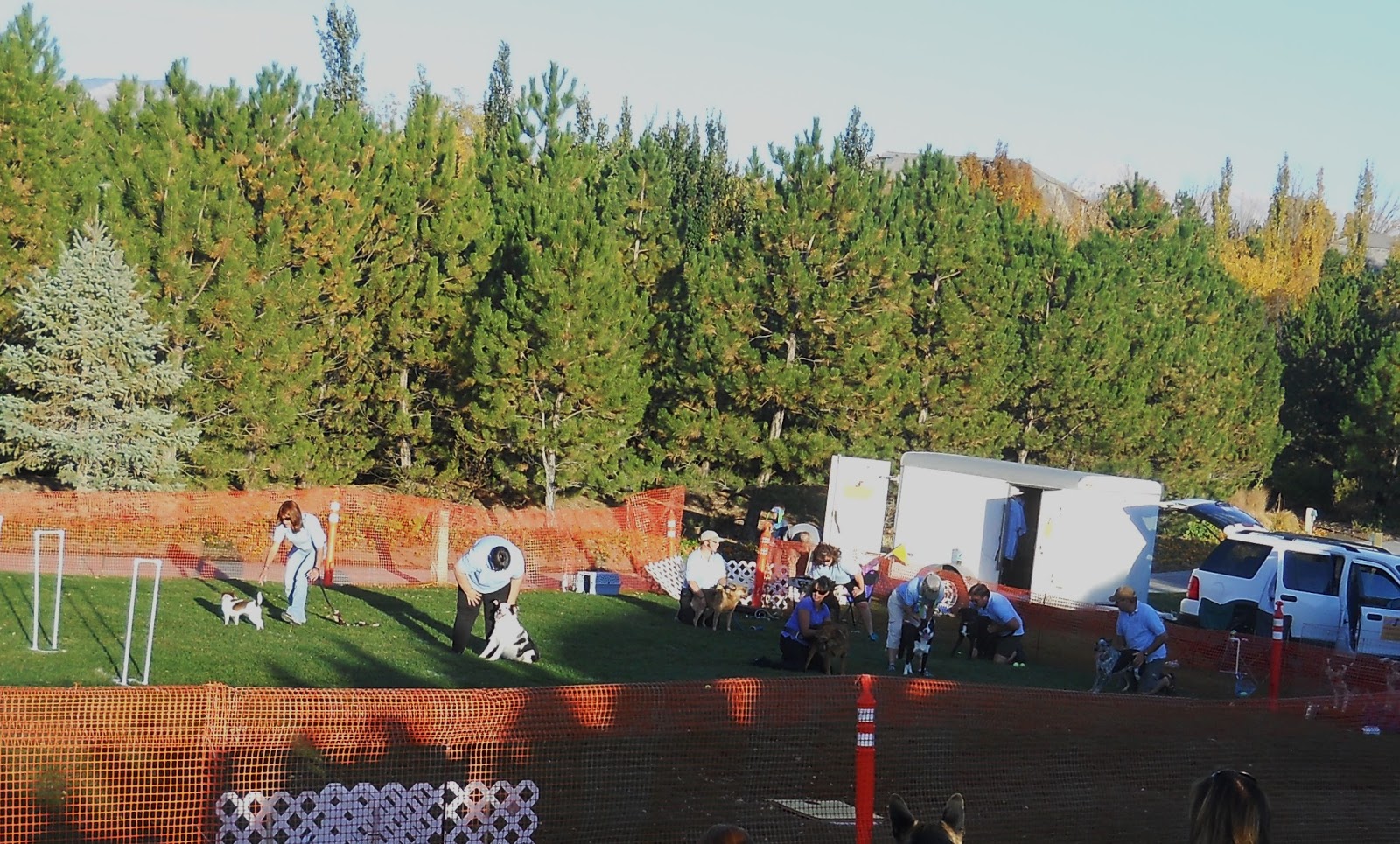
This year Thanksgiving Point held their annual Dog Days in their Gardens!
 Here we are heading down to the festivities!

 I have such a well loved dog! :o)
 but she did get tired of having her picture taken, she wanted to get to the other dogs

 Here was a neat fly ball demonstration!
 Really fun and a great way for your dog to stay happy and burn some energy off, and you can easily teach your dog to do this in your own backyard!
 Frodo, what a great shot!
 In Fly Ball they use tug ropes to get their dogs excited and ready to run!

 See all the fun dogs that were watching!


 Look at this cute little beggar!


 After the fly ball demonstration was done they allowed you and your dog to give it a go and see how they would do... Roxy did excellent! They said she would be welcome on the team anytime!


 Frodo got to give it a go as well... he was a bit shy at first, but he did really well too!


 Roxy checking out the Koi in the pond...
 Love the fall colors!!!
 Run Frodo, Run!
 Everyone love this part!

 This was just priceless!!! Strider checking out the waterfall with the kids

 more pretty fall colors!!!
Thanks Thanksgiving Point!!! We had a blast!!!

Saturday, September 29, 2012

Fence Aggression


I found this article when I was looking for things to put on my facebook page.  I recently had someone in one of my classes asking my why dogs behave like this.  Sad to say my answer wasn't as clear as this one is.  Don't get me wrong, I said the same thing, just not as well as Pat Miller, so please take it away Pat!


Better Designed Dog Fences Make for Better Dogs

Put a stop to fence-running, fence-fighting, and barking.

by Pat Miller
As I sit here writing, I hear a ruckus from my backyard. Leaning forward, I look out my window to see Dubhy the Scottie running the fenceline and barking madly at two black Labs who have wandered over from a distant neighbor’s house, still sporting the highly ineffective shock collars that are supposed to keep them home.
As I cuss under my breath yet again at my irresponsible neighbors and get up to call Dubhy in, I have a sudden epiphany. Three years ago when Dubhy’s on-again, off-again dog aggression erupted for the first time, it was directed at a black Lab. I have always wondered why . . . and suddenly I see it. There’s a good chance that Dubhy has a strong negative classical association with black Labrador Retrievers as a result of his irregular but frequent encounters-of-the-fence-kind with our neighbor’s wayward dogs. Duh!
If a dog has had ample opportunities to fence-run, fence-fight, or just bark madly when people pass by his yard, it can be challenging to stop these behaviors. Strict management of his environment to eliminate his “practice time” is critical.
In his famous poem, “Mending Wall,” Robert Frost starts out by saying, “Something there is that doesn’t love a wall.” We could revise that slightly to say “Something there is that doesn’t love a fence.”
That “something” is our dogs.
Fence-running, and its close cousin, fence-fighting, are manifestations of barrier frustration, also called restraint frustration. The frustration that a dog feels when he can see – but not reach – his objective can (and often does) give rise to canine obsessive-compulsive disorders (COCD) and aggression, both of which are serious behavior problems caused by stress.
Fence-running can quickly become a COCD. I see a mild version of it with Dubhy – stereotypic running along the fence line, accompanied by aroused barking, and spinning at the corners. He has a path worn around the interior of our large yard, which wasn’t there prior to his joining our family.
I have no doubt that if Dubhy were a (shudder) backyard dog, he would have serious problems. Instead, he’s only outdoors when we are home, and if he starts his fence-running behavior we interrupt it and bring him in. We are fortunate that our fence doesn’t conjoin any of our neighbors’ fenced-in dogs, or we would have to take much stronger steps to manage or retrain the behavior.
Restraint frustration also quickly turns into aggression. Aggression is caused by anxiety and stress, easily triggered by the arousal of fence-running. Some dogs who fence fight are fine if they meet the same dog sans barrier. Others, like Dubhy, may generalize their aggression to some or all dogs even when there’s no fence present.
As dog owners become more and more responsible about keeping their dogs safe at home, the incidence of fence-related behavior problems rises. Even the unfortunately popular underground electronic (shock) containment system fences can give rise to the problem. The barrier is there, even if the dog can’t see it, and the intense punishment of the shock the dog receives if he breaches the invisible barrier can intensify the resulting aggression.
Tying a dog outside also poses restraint frustration problem, and shares a drawback with electronic fences: neither prevents trespassers (human or otherwise) from invading the dog’s territory, putting both the trespasser and the dog at serious risk.
What’s an owner to do?
It sounds like you’re damned if you do, and damned if you don’t! If not confining your dog isn’t safe or responsible, and confining him causes behavior problems, what are you supposed to do with him?
This is a case where prevention and management are much easier solutions than training. There are a number of things you can do to reduce the likelihood and opportunity for fence running and fighting. You can:
• Install a solid fence. This is the best solution, albeit expensive, and in an increasing number of shortsighted communities, prohibited. If you block your dog’s visual access to the stimuli outside his fences, he’s not likely to get aroused enough to begin the undesirable behaviors. If you live in a no-fence community, you might want to consider moving.
• Keep your dog indoors. Dogs who are permanent outdoor residents are at high risk for fence-related behavior problems. There are many reasons it’s not wise to leave your dog outdoors when you’re not home; this is just one of them. If he’s out while you’re away, he’ll get lots of opportunities to practice fence-running and -fighting. The more he practices, the harder the behavior is to modify.
Do like we do with Dubhy: let your dog out in the yard for limited periods only when you’re home, and bring him in immediately if he starts the unwanted behaviors.
• Eliminate the stimuli. Dubhy’s fence problems are triggered by stray dogs and itinerant cats. We eliminated the majority of Dubhy’s fence running by adopting (with the neighbor’s blessing) the neighbor’s cat who had taken up residence in our barn. We had Barney vaccinated and neutered, and brought him indoors, solving a good percentage of Dubhy’s problem. (See “Barney Morphs Into Housie,” next page.) We’re still working on the black Labs.
• Modify your existing fence. If you have a see-through fence, like the ubiquitous chain-link enclosures common here in Tennessee, do something to make it more solid. There are slats available that you can slide into the chain link to block some of the visual stimuli. This will work with mild fence problems, but won’t deter a dedicated fence-runner or -fighter if he can still see through the gaps between the slats.
You can try the slats to see if they work, and if not, line the inside of the fence with something to block his view completely. FRP (fiberglass reinforced plastic) is probably the most durable option, also the most expensive and least visually offensive. Other options might be plywood, or tarps, at least temporarily.
• Install an “airlock,” another fairly costly option that can discourage fence-fighting. An airlock is created by building a second fence inside your existing one to create a “no-dog’s land” between your dog and your neighbor’s.
As an added benefit, this protects your dog from neighbor children sticking fingers and potentially harmful objects through the fence. While a double barrier can reduce actual fence-fighting, I am confident that this option would not have put a dent in Dubhy’s fence-running behavior.
Repair the damage
This dog used to spend much of his day scaring the wits out of unsuspecting passers-by. He would wait until a person was in front of the gate and then explode in a fit of barking at their feet. Recently, his owners sealed the gap, and once he could no longer scope out the sidewalk, he quit the bothersome activity.
If you have a dog who already manifests fence-related behaviors, you can do some training that will help you get a handle on the problem. You have probably already discovered how difficult it can be to call your dog to you when he is in a state of high arousal, racing along the fence in futile, frustrating pursuit of his adversary.
Your first challenge is to find a way through the fog in his brain so he can even acknowledge your presence. With Dubhy, I found that standing directly in his path didn’t work. He simply darted around me and continued on his mission. I know better than to try the lunge-and-grab method, which would only serve to make him wary of me. Tossing something like a treat or a ball to try to break his focus was equally ineffective.
I began a two-pronged training program, one to counter-condition him to the presence of the arousal-causing stimuli, and the other to improve his recall response, even in the face of high distractions.
Come again?
The recall training was easiest to implement, as I could do it any place, any time. Dubhy already had a rock-solid and speedy recall in the training center, but it was somewhat less reliable in the backyard, and even less so in wide open spaces. I was already fed up with his “maybe” recall, after being forced on several occasions to go out and get him in the dark when he declined to come back indoors after the pack’s bedtime bathroom break.
We embarked on backyard and long line recall training. Several times a day I would play with Dubhy in the backyard, calling him, giving him a high-value reward (such as canned chicken or fish), and letting him go again. Especially since Dubhy prefers outdoors to indoors – the first dog I have ever had who exhibited this bizarre preference – I didn’t want his recall to be a predictor of “outdoors is over” by bringing him indoors every time I called him.
I would also call him to the back deck and cue him to do several of his tricks for high value rewards, since he likes to do tricks. And I called him and had him do several pieces of agility equipment; he loves his agility stuff. Gradually his recall responses improved.
I even used a little negative punishment on one occasion, when he failed to come for dinner call. Rather than trekking out to get him, I let him stay out, and didn’t serve him his meal when he finally did deign to come in. He hasn’t missed dinner call since.
In addition, we worked on recalls in wide open spaces on his long line, until I started getting snappy responses, even spinning on his heels if he was heading in the other direction. We now take a chance on our five acres and occasionally let him off-leash to practice recalls outside the yard. Most of the time, he comes when called. Every once in a while his Scottie brain takes over, and I have to retrieve him before he wanders off the property.
I also did counter-conditioning work with him. Whenever the opportunity presented itself – with the neighbor dogs or Barney – I went out in the yard and waited for a brief lapse in Dubhy’s fence-focused attention, then offered him yummy treats. At first he would grab a treat and go right back to his running and barking. My ability to keep him focused on me and the treats was in direct proportion to the distance to the stimulus. If the neighbor dogs appeared to be just passing through, Dubhy would stay more attentive to me as they moved away. Over time, as we worked on it, he would turn his attention to me and keep it there with the dogs in closer and closer proximity.
Barney, who loved to tease Dubhy by rolling around on the driveway six feet from the fenceline, was more of a challenge. But with time and practice, I could even call Dubhy away from his feline nemesis.
Band-Aid, not a cure
What I have accomplished with Dubhy is a compromise, not a cure. He still “goes off” when neighbor dogs pass by; it’s just easier for me to interrupt his behavior and call him into the house. If I were to leave him in the backyard unattended he would continue his arousal behavior and the COCD nature of his actions, especially the spinning, would probably worsen.
I’m still dealing with the collateral damage of his fence behaviors; specifically, his aggression toward some dogs, especially black Labs. When we are out in the world and he sees another dog he will go on alert – tail up, ears pricked, eyes bright, leaning forward. Then, unless it’s a Lab, he’ll swivel his head toward me to ask for his treat – the positive result of lots of counter-conditioning. With Labs, I still have to draw his attention to me; he doesn’t offer it on his own. I can gauge how aroused or relaxed he is by the amount of pressure from his teeth when he takes the treat from my fingers. With Labs, his teeth definitely hurt.
It would be a very large challenge to counter-condition a dogs’ fence-running or -fighting behaviors to the point that the behavior goes away. Even if you succeed in habituating your dog to the presence of the arousal-causing stimuli, the chances of spontaneous recovery are very high; the behavior is likely to resurrect itself with additional exposures to the stimuli.
Prevention is your best course of action, by not putting your dog in a position to develop the behaviors in the first place – not leaving him fenced and unattended. If it’s too late for prevention, management is your next best bet – putting up a solid fence and/or not leaving in him the yard alone.
If at any time you feel that you and your dog are not making progress, or your dog is exhibiting signs of a serious COCD, contact a good positive behavior consultant or veterinary behavorist. She can evaluate your training and help you investigate the possibility of using behavior modification drugs to control obsessive behaviors that may be interfering with the success of your program.
The property we are hoping to purchase in Maryland is in the middle of 80 rural acres, and the backyard is fenced with a solid wooden fence. Sounds like a great management plan to me!
Robert Frost’s neighbor was right; good fences do make good neighbors, and especially better neighbor dogs!

-Pat Miller, WDJ’s Training Editor, is a Certified Pet Dog Trainer, and past president of the Board of Directors of the Association of Pet Dog Trainers. She is also the author of The Power of Positive Dog Training and Positive Perspectives: Love Your Dog, Train Your Dog. See “Resources” for contact and purchasing information.


http://www.whole-dog-journal.com/issues/7_4/features/Best-Dog-Fences_5620-1.html

Friday, September 14, 2012

Learning to Speak Dog!

I found this great blog post from "Tails from the Lab" while looking for things to put on my facebook page.

http://www.tailsfromthelab.com/2012/08/29/learning-to-speak-dog-part-4-reading-a-dogs-body/

She uses these illustrations in the article, but please read the article as well, it has some very good information if you were ever wondering "why your dog did that."


Saturday, September 8, 2012

Doggy play day!

Our September Play day will be on Thurday the 13th at 7pm.  Meet in my backyard and bring your friends!!! I will have treats to munch on for us humans, while our 4 legged friends play!

September "Mutt of the Month"!


Gumby is our September "Mutt of the Month"!

What a fun little guy he is!  He loves to play and run and jump!!!